Cybersecurity has historically been built around a simple operational model: detect a problem, alert a human, and wait for a response. This model worked when infrastructure was small, attack volume was manageable, and systems changed slowly. Today, none of those assumptions hold.
Modern environments generate massive event volume across cloud services, endpoints, identity systems, applications, APIs, and increasingly, ai-assisted workflows. Detection volume has increased faster than analyst capacity. Alert fatigue is no longer a temporary operational problem — it is a structural limitation of human-centered security operations.
At the same time, systems are becoming more autonomous. Cloud orchestration, auto-scaling platforms, ci/cd pipelines, and agent-like tooling now make decisions continuously without human intervention. Security tooling, however, often remains stuck in a reactive model that assumes a human will always be in the loop.
If modern infrastructure is autonomous, modern defense must evolve accordingly. This article outlines closed-loop security systems: defensive architectures that observe, interpret, act, and learn continuously while enforcing safety boundaries. The goal is not to remove analysts. The goal is to reserve human attention for oversight, tuning, and exceptions — and let automation handle routine response work that does not deserve a human.
The limits of alert-driven security
Most soc workflows follow an open-loop pattern:
- telemetry is collected
- detections fire
- analysts triage and investigate
- actions are executed manually
As coverage expands, this model accumulates operational debt instead of resilience.
- latency accumulation: every manual step adds delay, and fast-moving cloud incidents outrun humans
- alert inflation: as detection coverage grows, noise grows unless tuning scales with it
- cognitive overload: analysts context switch across tools and incomplete data under time pressure
- inconsistent response: two humans may respond differently to the same scenario based on fatigue and experience
Open-loop systems scale detection faster than they scale resolution. Over time, the soc becomes a queue: alerts are produced efficiently, but containment becomes the bottleneck.
What “closed-loop” means in security
Closed-loop systems are common in control theory, robotics, and industrial automation because they remain stable under changing conditions. They do not stop at observation — they incorporate outcomes back into future decisions.
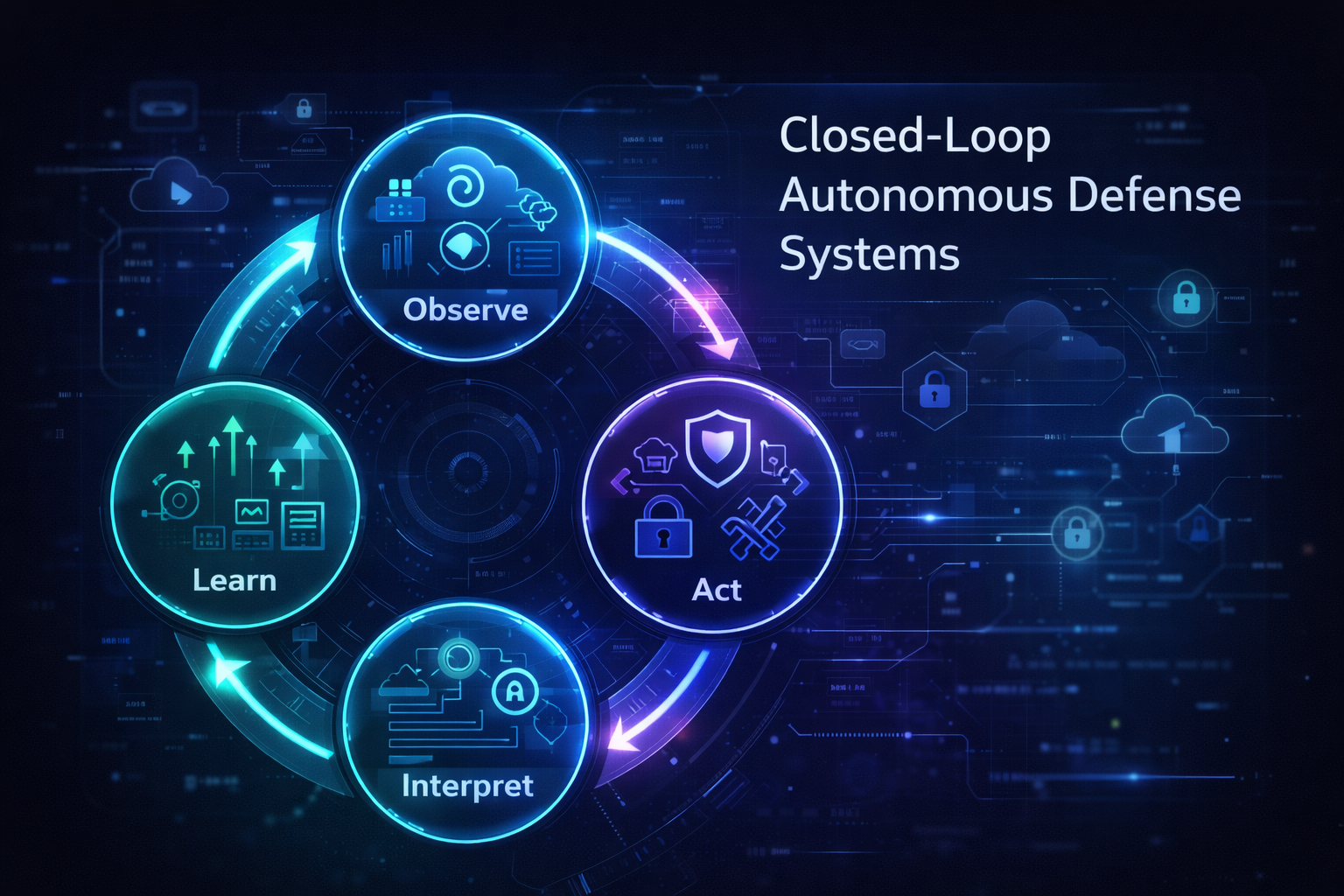
In security, a closed-loop defensive system has four stages that repeat continuously:
- observe: collect telemetry across infrastructure, identity, application, and behavioral signals
- interpret: correlate signals, estimate risk, and determine confidence levels
- act: execute bounded response actions automatically when confidence thresholds are met
- learn: measure outcomes and refine thresholds, models, and policies over time
Instead of producing an alert and stopping, the system decides whether action is appropriate, executes a bounded response, and then measures the outcome.
The future soc should behave less like a ticket queue and more like a control system: sense → decide → act → learn.
Designing safe autonomy
The hardest part of defense automation is not feasibility — it is safety. Poor automation can cause outages, block legitimate users, or cascade failures across production systems. Closed-loop defense requires guardrails by design, not as an afterthought.
- bounded actions: default to reversible, low-risk responses such as temporary isolation, session termination, or scoped policy tightening
- progressive escalation: higher impact actions require higher confidence or explicit human approval
- rate limiting and dampening: prevent oscillations where repeated actions destabilize the environment
- auditability: every decision must be observable, explainable, and replayable for forensics and tuning
- fail-safe behavior: when telemetry becomes unreliable, degrade gracefully rather than acting aggressively
Autonomy is not binary. It exists on a spectrum that can be tuned per environment, workload, and risk tolerance. The best systems start conservative and earn increased autonomy through evidence.
Risk scoring as the decision engine
At the core of a closed-loop system is a decision engine. In practice, this is rarely a single rule. It is a scoring mechanism that estimates risk and confidence based on multiple signals.
Effective risk models incorporate:
- signal confidence and source reliability
- historical behavior and baselines
- asset criticality and blast radius
- correlation strength across independent signals
- temporal patterns: bursts, repetition, and sequence of events
Risk scoring enables nuanced behavior. Low-confidence indicators can accumulate before action. Repeated benign behavior can lower sensitivity. High-impact assets can enforce stricter thresholds. The system becomes adaptive without becoming opaque.
Feedback loops and continuous calibration
Closed-loop systems only remain effective if they learn from outcomes. Without feedback, automation drifts into irrelevance or becomes dangerous. Calibration can start simple: threshold tuning, suppression logic, and weighted scoring adjustments. Over time, more advanced evaluation can be introduced, but only when the system can measure real outcomes reliably.
Feedback sources may include:
- success or failure of automated responses
- false positive and false negative patterns
- analyst overrides and exception handling
- environmental drift: new services, users, and behaviors
- adversarial adaptation: when attackers shift tactics in response to controls
Failure modes to anticipate
Closed-loop defense introduces new risks. These are manageable, but only if they are modeled explicitly.
- automation bias: operators over-trust automation and fail to challenge incorrect decisions
- feedback poisoning: attackers manipulate telemetry to influence future thresholds or suppression logic
- blind spots: overfitting to known patterns creates gaps for novel attack paths
- system coupling: tightly integrated automation amplifies downstream failures when dependencies degrade
These risks reinforce why observability, simulation testing, and staged rollouts are not optional. A closed loop should be validated under adversarial pressure before it is granted autonomy in production.
Reference architecture
A practical closed-loop architecture is best modeled as loosely coupled components with clear interfaces. This improves safety and makes partial failure survivable.
Typical components:
- event ingestion layer
- normalization and enrichment pipeline
- correlation engine
- risk scoring module
- policy and threshold layer
- response orchestration engine
- audit log + replay store
- feedback telemetry store
- operator control interface
Each component should be observable independently. If a dependency degrades, the loop should degrade gracefully: fall back to alert-only mode, reduce response scope, or require approval for actions.
The operator role in an autonomous soc
Closed-loop defense does not eliminate analysts — it shifts them toward higher leverage work. Humans supervise the system rather than react to every individual detection.
Operators shift toward:
- policy tuning and threshold calibration
- exception handling and approval workflows
- threat modeling and scenario design
- automation validation and regression testing
- post-incident analysis and learning integration
Why this matters now
Cloud infrastructure and ai-assisted workflows have changed operational tempo. Attackers already use automation and scale; defenders must match that velocity without sacrificing safety.
Closed-loop defense offers an architectural path forward — not as a silver bullet, but as an evolution that acknowledges complexity and uncertainty. Organizations that invest early in safe automation gain resilience advantages that compound over time.
Closing thoughts
Security maturity is no longer defined by how many alerts you generate. It is defined by how effectively your systems respond under uncertainty.
Designing closed-loop defense is an engineering challenge: it requires systems thinking, safety discipline, observability, and continuous calibration. The future soc will look less like a queue and more like a control system.