Research
SynAccel is an independent security research ecosystem focused on AI security, cloud security, autonomous detection, and adversarial testing of modern systems. This page summarizes the themes, methods, and prototypes behind that work.
How we research
We build prototypes to pressure-test assumptions: how detections behave, how automation fails, and how adversaries exploit gaps across AI-assisted workflows and cloud environments. The output is practical: measurable behavior, reproducible experiments, and systems that improve detection and response reliability.
Research principles
This work is intentionally hands-on: code first, measurable behavior, and repeatable experiments. If it can’t be tested, it can’t be trusted.
- prototype-driven: small, shippable experiments
- adversary-minded: validate with attacker behavior
- automation-aware: safe defaults + guardrails
- operator-friendly: clarity beats complexity
Focus areas
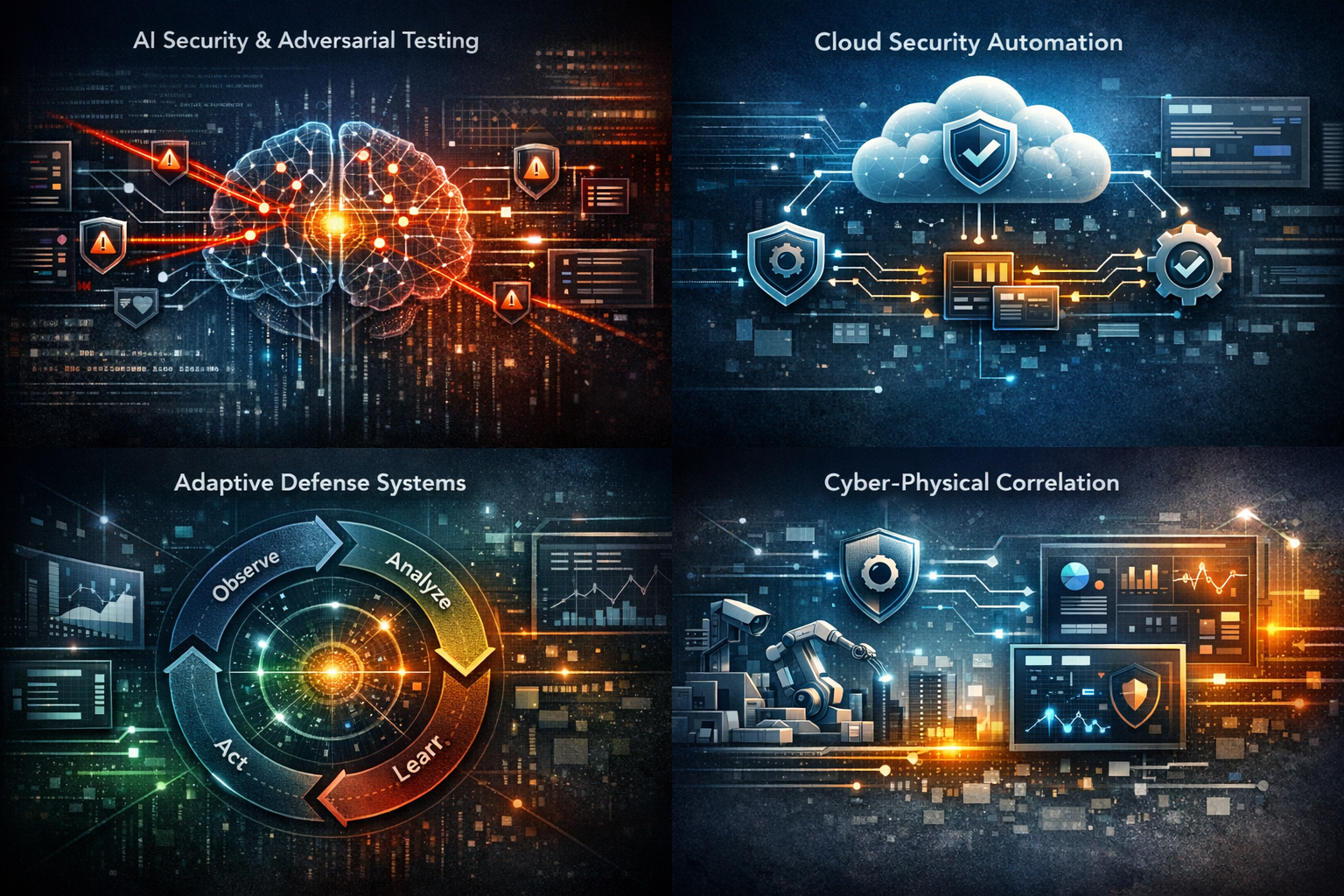
AI security & adversarial testing
Researching how AI-assisted systems can be manipulated (prompt injection, tool misuse, unsafe actions) and how to design guardrails that hold up under adversarial pressure.
- prompt injection + tool misuse scenarios
- evaluation harnesses for red-team testing
- defensive patterns for safer AI workflows
Cloud security automation
Building detection and response loops that reduce manual triage and improve time-to-containment in cloud environments.
- event-driven alerting and correlation
- response automation with safety controls
- repeatable lab environments for validation
Adaptive defense systems
Prototyping systems that observe, interpret, act, and learn — instead of relying only on static detection rules.
- feedback loops that reduce noise over time
- risk scoring and response tiering
- adversarial validation of detections
Cyber-physical correlation
Connecting physical telemetry and digital security signals so anomalies can be understood across the full system.
- telemetry ingestion pipelines
- near-real-time correlation logic
- operator-friendly views and summaries
Highlighted prototypes
Automated cloud-security detection and response framework for adaptive defense across AWS environments.
- focus: security automation + detection loops
- direction: composable detectors + safer response actions
Cyber-physical event bridge prototype.
- focus: telemetry ingestion + correlation
- direction: linking physical context to security signals
Adaptive cognitive deception for real-time misdirection.
- focus: deception patterns + attacker misdirection
- direction: adaptive artifacts and realistic breadcrumbs
Sandbox for testing prompt injections, jailbreaks, and AI red teaming techniques.
- focus: repeatable AI red-team tests
- direction: structured scenarios + evaluation outputs
Shared tooling and scaffolding for SynAccel prototypes.
- focus: repo templates, utilities, and consistency
- direction: reusable components for rapid experimentation
Collaboration
If you’re interested in collaborating, reviewing designs, or discussing research directions, reach out. Contributions and thoughtful critique are welcome.